If you're new here, you may want to get regular updates via Si vous êtes nouveau ici, vous pouvez obtenir des mises à jour régulières via RSS feed Flux RSS . . Thank you for visiting! Merci de votre visite!
A missionary under the Yahoo! Un missionnaire en vertu de la Yahoo! Groups nome de plume of “Patriot Tim” has made Groupes nome de plume de "Patriot Tim» a fait an allegation une allégation in a discussion group by stating that the Syrian pagan idol RIMMON () as mentioned in 2 Kings 5:18 is the same Deity as for the Muslims, who sometimes call upon God as ar-rahman (The Merciful). dans un groupe de discussion en affirmant que la Syrie idole païenne Rimmon () tel que mentionné dans 2 Rois 5:18 est la divinité même que pour les musulmans, qui, parfois, faire appel à Dieu comme al-Rahman (Le Miséricordieux). To repeat the missionary's claim: Pour répéter le missionnaire réclamation:
The verse in question is II Kings 5:18, and the words were spoken by Naaman the Syrian general who had just been healed of his leprosy by Elisha the prophet [....] We see Naaman saying that, because of his position of importance to the king of Syria, he would be required to enter and bow to Rimmon in that deity's temple in Damascus. Le verset en question est II Rois 5:18, et les paroles ont été prononcées en disant Naaman syrienne le général qui venait d'être guéri de sa lèpre par le prophète Elisée [....] Nous voyons que Naaman, en raison de sa position de importance pour le roi de Syrie, il serait nécessaire d'entrer et de se plier à Rimmon dans ce temple de divinité à Damas. Thus, we see that RIMMON is found in the Bible. Ainsi, nous voyons que Rimmon se trouve dans la Bible.
This article is more or less an improvement from the Cet article est plus ou moins une amélioration de la original response réponse originale we had offered and is intended to deeply address the issue of RIMMON, insha'allah. nous avions offert et est destiné à profondément la question de Rimmon, Insha'Allah.
Is RIMMON really “Rahman”? Est-Rimmon vraiment "Rahman"?
On the issue of “Rahman”, the missionary argues that Sur la question de "Rahman", le missionnaire fait valoir que
Rahman, as indicated to us in the Qu'ran, Surah 17:110, is another name for All?h. Rahman, comme nous a indiqué dans le Coran, sourate 17:110, est un autre nom pour tous h.? Hence, we see that there is a definite connexion, linguistic and otherwise, between the Rimmon who was worshipped all throughout Syria, Paddan-Aram, Assyria, and the rest of the northern Fertile Crescent, and Rahman, or All?h. Ainsi, nous voyons qu'il ya un lien précis, linguistiques et autres, entre les Rimmon qui était adoré tout au long de la Syrie, Paddan-Aram, Assyrie, et le reste du nord du Croissant Fertile, et Rahman, ou tout h.?
We believe that we have had tolerated enough of this shoddy scholarship, and now is the time to blast this missionary to kingdom come. Nous croyons que nous avons eu assez de tolérer cette bourse d'études de pacotille, et c'est maintenant le temps de souffler ce missionnaire au règne vienne. The reality is that one does not need the source(s) that he dutifully parrots from Christian polemicists like Dr. Robert Morey, as The New Strong's Exhaustive Concordance of the Bible, The Brown-Driver-Briggs Hebrew-English Lexicon and William Gesenius' Hebrew and English Lexicon are all good enough authorities on the etymology. La réalité est que l'on n'a pas besoin de la source (s) qu'il perroquets consciencieusement des polémistes chrétiens comme le Dr Robert Morey, comme l'homme fort du Nouvel exhaustive Concordance de la Bible, le Brown-Driver-Briggs hébreu-anglais Lexique et William Gesenius ' hébreu et en anglais Lexique toutes les autorités sont assez bien sur l'étymologie.
As we have earlier stated, the name of this Syrian pagan idol RIMMON appears in 2 Kings 5:18. Comme nous l'avons indiqué précédemment, le nom de cette idole païenne Rimmon syrienne apparaît dans 2 Rois 5:18. This verse is as follows: Ce verset est comme suit:
May the Lord forgive your servant in this matter: when my master enters the house of RIMMON to worship there, supported by my hand, and I have to bow myself down in the house of RIMMON; when I have to bow myself down thus in the house of RIMMON, may the Lord forgive your servant in this matter. Que le Seigneur pardonne à ton serviteur en la matière: quand mon maître entre dans la maison de Rimmon pour adorer là, soutenu par ma main, et je dois me prosterner dans la maison de Rimmon, quand je dois me prosterner ainsi dans la maison de Rimmon, le Seigneur pardonne à ton serviteur en la matière.
According to Gesenius, the Hebrew word “rimmon” actually means “pomegranate,” and the Arabic equivalent is “rumman”, which is quite similar to the Hebrew and shares the same RMN cognate[1]. Selon Gesenius, le mot hébreu "Rimmon" signifie "grenade", et l'équivalent en arabe est "Rommane", qui est assez semblable à l'hébreu et les actions de la même apparenté RMN [1]. The following image would clearly illustrate this relation: L'image suivante serait illustrent clairement cette relation:
“Pomegranate” is thus the proper translation of “rimmon” in the Bible (Numbers 20:5; Deuteronomy 8:8; 1 Samuel 14:12; Songs 4:3, 6:7). "Grenade" est donc la bonne traduction de "Rimmon" dans la Bible (Nombres 20:5; Deutéronome 8:8; 1 Samuel 14:12; Songs 4:3, 6:7). 'Rimmon' is also the name of a number of places mentioned in the Bible, specifically the Old Testament, named such because of the number of pomegranates that grow there. «Rimmon 'est aussi le nom d'un certain nombre de lieux mentionnés dans la Bible, l'Ancien Testament en particulier, du nom de cette raison du nombre de grenades qui y poussent. As Gesenius states: Comme le dit Gesenius:
The pomegranate tree is still found in Syria, Palestine, and Egypt [...] From their abounding in pomegranates, several places received the proper name Rimmon[.][2] Le grenadier est toujours présent dans la Syrie, la Palestine et l'Egypte [...] De leur riche en grenades, plusieurs endroits ont reçu le bon nom de Rimmon [.] [2]
Examples of such places being named 'Rimmon' can be seen in Joshua 15:32, 19:7; Judges 20:47; 1 Chronicles 4:32 and Zechariah 14:10. Des exemples de tels lieux d'être nommé «Rimmon» peut être vu dans Josué 15:32, 19:7; 20:47 juges; 1 Chroniques 4:32 et Zacharie 14:10. Indeed, until today there is a specific place in Palestine called Rimmon (reysh-mem-vav-nun) in Hebrew, and Rammwan/Rummon (raa-meem-waw-nun) in Arabic, and it still exists today. En effet, jusqu'à aujourd'hui, il ya une place spécifique dans la Palestine a appelé Rimmon (reysh-mem-vav-religieuse) en hébreu, et Rammwan / Rummon (raa-mime-waw-religieuse) en arabe, et il existe encore aujourd'hui.
We can see that Rammwan/Rummon is thus the closest Arabic equivalent to the Hebrew “rimmon”, and not “Rahman” as Patriot Tim erroneously asserts. Nous pouvons voir que Rammwan / Rummon est donc le plus proche équivalent arabe de l'hébreu "Rimmon", et non pas "Rahman" Patriot comme Tim affirme à tort.
Referring to Strong's on RIMMON, the following entry is found: Se référant à forte sur Rimmon, l'entrée suivante est trouvée:
4. 4. A Syrian god (7417)[3] Un dieu syrien (7417) [3]
The BDB Lexicon has more information on RIMMON, and on p. Le lexique BDB a plus d'informations sur Rimmon, et p. 942 we read that: 942, nous lisons que:
[Rimmon] n. [Rimmon] n. pr. pr. dei; as Rammanu, god of wind, rain and storm; thunder; storm.[4] dei; que Rammanu, dieu du vent, la pluie et la tempête; tonnerre, la tempête [4].
There are two possible etymological explanations for the RIMMON of Syria. Il ya deux explications possibles pour le Rimmon étymologique de la Syrie. The first is from Gesenius, who says that it is “…perhaps the exalted, from the root RMM.”[5] The other possibility is that the spelling is a deliberate Jewish insult, and this is not uncommon in the Bible. La première est de Gesenius, qui dit qu'il est «... peut-être l'exaltation, de la RMM racine." [5] L'autre possibilité est que l'orthographe est une insulte délibérée juive, et ce n'est pas rare dans la Bible. We read that Nous avons lu que
“Rimmon” is an epithet of Hadad (Adad in Mesopotamia); the Akkadian form is Ram(m)an. "Rimmon» est une épithète de Hadad (Adad en Mésopotamie), la forme akkadienne est Ram (m) un. It has been suggested that the Hebrew Rimmon, which is identical to the Hebrew word for “pomegranate,” is a deliberate mispointing of an original Ram(m)an (or something similar) to disparage the deity. Il a été suggéré que le Rimmon hébreu, qui est identique au mot hébreu pour "grenade", est un dépointage délibérée d'un original Ram (m) une chose (ou similaire) à dénigrer la divinité. This epithet Rimmon/Ramman is best understood as “thunderer” (cf. Akkadian ramanu “to roar,” hence “to thunder”). Cette épithète Rimmon / Ramman est mieux comprise comme «Tonnerre» (cf. ramanu akkadien "à rugir," donc "à Thunder"). Accordingly, the name Hadadrimmon means “Hadad is the thunderer.” Hadad, or Rimmon/Ramman, was the chief diety of the Arameans of Syria[.][6] En conséquence, le Hadadrimmon le nom signifie «Hadad est le Tonnant. Hadad, ou Rimmon / Ramman, était la principale divinité des Araméens de Syrie [.] [6]
In light of Jewish traditions with disparaging name-games in Hebrew, we favour the possibility that calling the Syrian pagan idol as RIMMON was merely an attempt at insulting this pagan deity, and have no connections with “rimmon” meaning “pomegranate”. À la lumière des traditions juives avec désobligeantes nom-jeux en hébreu, nous sommes favorables à la possibilité que l'appel de l'idole païenne syrien Rimmon était simplement une tentative insultante cette divinité païenne, et n'ont aucun rapport avec "Rimmon" qui signifie "grenade".
This is already enough to refute the missionary's mendacity. C'est déjà suffisant pour réfuter les mensonges du missionnaire. But let us take one step further and look up the meaning of the Arabic ar-rahman, as stated in Hans Wehr's Arabic-English Dictionary: Mais prenons un peu plus loin et de rechercher le sens de l'ar-Rahman en arabe, comme l'indique Hans Wehr en arabe-anglais:
ar-rahman : the Merciful (ie God)[7] ar-Rahman: le Miséricordieux (Dieu) [7]
The root of ar-rahman is the word rahma, and from the very same page, we find that the root means La racine de l'ar-Rahman est le mot Rahma, et de la même page, on trouve que la racine des moyens
pity, compassion; human understanding, sympathy, kindness; mercy[8] pitié, la compassion, la compréhension de l'homme, la sympathie, de bonté; [merci 8]
Clearly, we certainly do not see any etymological relation at all with the Hebrew noun RIMMON (). De toute évidence, nous n'avons certainement pas voir aucun rapport étymologique du tout avec le nom hébreu Rimmon (). Indeed, one does not blindly assume that a word is connected to another simply by the play of sounds, and we need to look at several established rules for finding etymological connections. En effet, on n'a pas aveuglément supposer qu'un mot est connecté à un autre tout simplement par le jeu des sons, et nous avons besoin de regarder plusieurs règles établies pour trouver des liens étymologique. The rules are: Les règles sont les suivantes:
So what does this mean? Alors qu'est-ce que cela signifie? It means that the languages have to originate near one another, and indeed Hebrew and Arabic are from the same branch and area. Cela signifie que les langues ont à l'origine près de l'autre, et même l'hébreu et l'arabe sont de la même branche et la région. They have to share the same cognate, and lastly, they have to share the same meaning. Ils doivent partager le même apparenté, et enfin, ils doivent partager le même sens. While we do not deny that the Hebrew noun RIMMON conforms with criteria 1, it does not conform with criterias 2 and 3, and hence fails the ruling for determining whether RIMMON is indeed related to the Arabic word ar-rahman. Bien que nous ne nions pas que le mot hébreu Rimmon conforme aux critères 1, il n'est pas conforme aux critères 2 et 3, et échoue donc la décision pour déterminer si Rimmon est effectivement liée au mot arabe al-Rahman. As one of the greatest Philosophers of Language (one of the founding fathers of the field), Ludwig Wittgenstein, put it: Comme l'un des plus grands philosophes du langage (l'un des pères fondateurs du champ), Ludwig Wittgenstein, a dit:
The meaning of a word is its use in the language.[9] La signification d'un mot est son usage dans la langue [9].
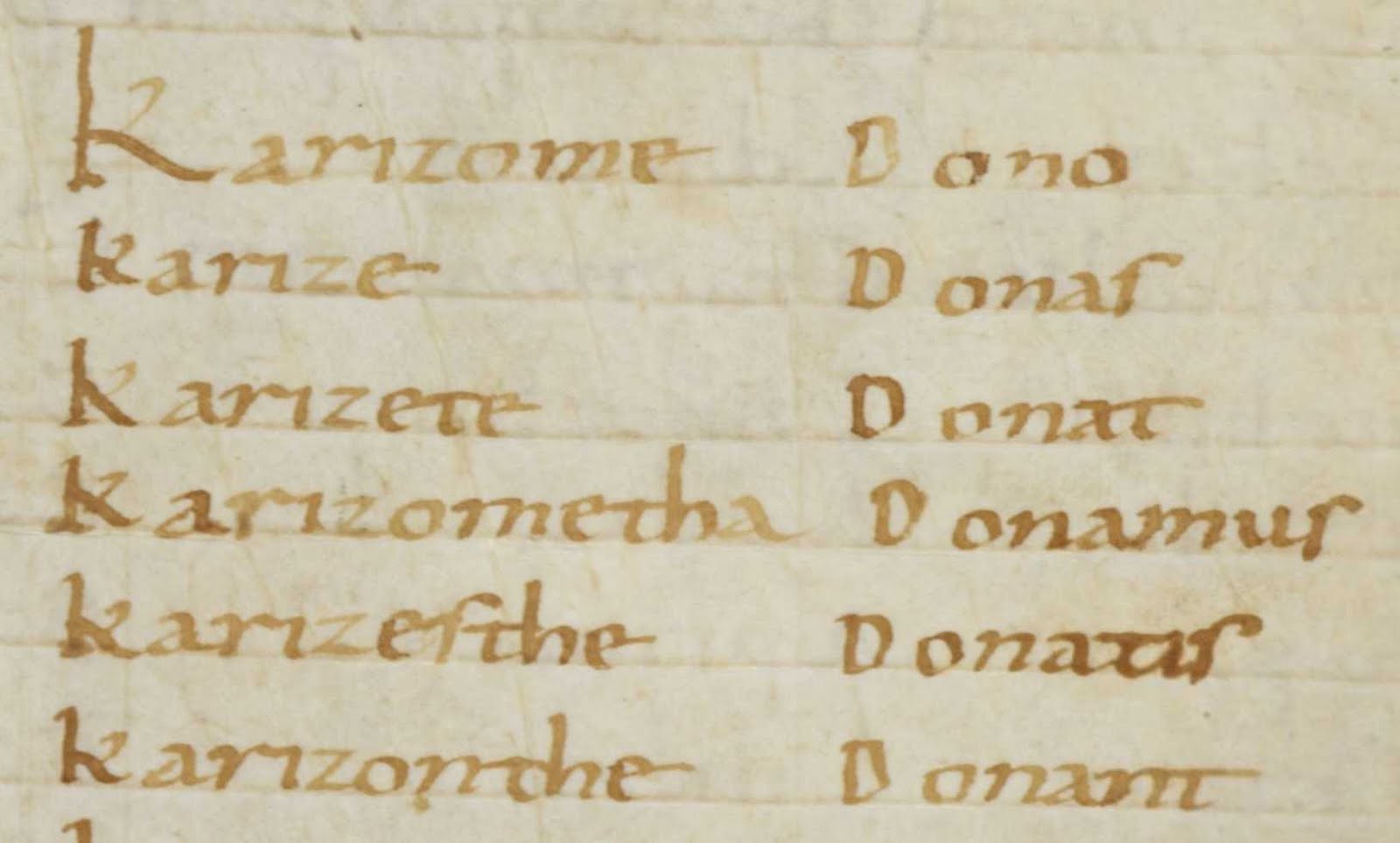
The equivalent word for ar-rahman in the Hebrew would be “Ha-Rachman”, as found in Rivlin's Hebrew translation of the Qur'?n, 1:1: Le mot équivalent pour les ar-Rahman en hébreu serait "Ha-Rachman", que l'on trouve dans la traduction en hébreu de Rivlin n le Coran?, 1:1:
In the name of God, Ha-Rachman, the Merciful[10] Au nom de Dieu, Ha-Rachman, le [Miséricordieux 10]
Apparently this title is not alien to the South Arabian Christians, for Philip K. Hitti informs us the following: Apparemment, ce titre n'est pas étranger aux chrétiens l'Arabie du Sud, de Philip K. Hitti nous informe ce qui suit:
The earlier South Arabian civilization could not have altogether passed away without leaving some trace in its northern successor. La civilisation antérieure Arabie du Sud ne pouvait pas tout à fait disparu sans laisser de trace dans le nord de son successeur. The inscription (542-3) of Abrahah dealing wih the break of the Ma'rib Dam begins with the following words: “In the power and grace and mercy of the Merciful [Rahman-an] and His Messiah and of the Holy Spirit”. L'inscription (542-3) de Abrahah traitant wih la rupture du barrage de Marib commence par les mots suivants: «Par la puissance et la grâce et la miséricorde du Miséricordieux [Rahman-an] et de son Messie et de l'Esprit Saint" . The word Rahman-an is especially significant because its northern equivalent, al-Rahman, became later a prominent attribute of All?h and one of His names in the Koran and in Islamic theology.[11] Le mot Rahman-an est particulièrement importante parce que son équivalent nord, Al-Rahman, est devenu plus tard un attribut important de tous les h? Et un de ses noms dans le Coran et dans la théologie musulmane [11].
Philip K. Hitti further informs us in a footnote that Philip K. Hitti nous informe en outre dans une note que
Rahmanan appears as title of the Christian God in a fifth-century South Arabic inscription.[12] Rahmanan semble que le titre du Dieu des chrétiens dans une inscription du Ve siècle Sud arabe [12].
So we see that the South Arabic Christians themselves using the appelation Rahmanan for their God, and hence we begin to see how perjurious the claims of the missionary really is. Nous voyons donc que les chrétiens du Sud eux-mêmes en arabe en utilisant le Rahmanan appelation pour leur Dieu, et donc nous commençons à voir comment parjure les revendications du missionnaire est vraiment.
The Aramaic word for Rachaman/Rahman is rachamanaa, and indeed this is found in the Talmud. Le mot araméen pour Rachaman / Rahman est rachamanaa, et en fait cela se trouve dans le Talmud. Consider the Aramaic text of Qiddushin 81b, where it is recommended that those looking to be protected from evil say: Examiner le texte araméen de Qiddushin 81b, où il est recommandé que ceux qui cherchent à être protégés contre les dire du mal:
Rachamanaa nighar beih ba-Satan Rachamanaa nighar Beih ba-Satan
Translation: May the Most Merciful rebuke Satan. Traduction: Que le Miséricordieux reproches plupart Satan.
In the same part of the Talmud, there is a fascinating story about Rabbi Chiyya: Dans la même partie du Talmud, il ya une histoire fascinante à propos de Rabbi Chiyya:
Rabbi Chiyya bar Ashi hawah raghil kal eedan dahawah nafal l'apeih hawah amar: ha-Rachaman yatsileinu miyetser haraa' Rabbi bar Chiyya raghil Ashi Hawah dahawah eedan kal l'apeih Hawah Amar nafal: ha-Rachaman haraa miyetser yatsileinu '
Translation: Rabbi Chiyya bar Ashi had a practice where everytime he prostrated he would say “may the Most Merciful save us from evil inclinations”. Traduction: Rabbi bar Chiyya Ashi avait une pratique où chaque fois il se prosterna, il disait: «Que le Miséricordieux nous sauver de mauvais penchants».
So, even the great Talmud sages were doing as the Muslims do to this day, prostrating and giving homage to the Most Merciful, ar-rahman. Ainsi, même les grands sages Talmud faisaient que les musulmans ne à ce jour, se prosternant et donnant hommage à la Très Miséricordieux, ar-Rahman. This passage from the Talmud is still relevant, as there is yet one more point to be made here. Ce passage du Talmud est toujours pertinent, car il ya encore un autre point à faire ici. Later in the story Rabbi Chiyya is tempted by his wife, who asks him to bring him a pomegranate. Plus tard dans l'histoire Rabbi Chiyya est tenté par sa femme, qui lui demande de lui apporter une grenade. She is quoted as saying: Elle est cité comme disant:
aiytei neehaleih l'hakh rumanaa d'reish tsutsitaa shawur aazal neehaleih aiytei l'rumanaa hakh d'shawur tsutsitaa Reish aazal
Translation: Bring me that pomegranate on the uppermost branch. Traduction: Apportez-moi que la grenade sur la branche la plus élevée.
The word for pomegranate in the Aramaic is rumanaa, which is quite close to the Arabic rumman. Le mot de grenade dans l'araméen est rumanaa, ce qui est assez proche de la Rommane arabe. What we learn from this is that in Hebrew, Arabic, and even Aramaic (from this look at Qiddushin 81b), there is no connection between the word for “Most Merciful,” a name given to God, and pomegranate, a name heaped upon a pagan deity. Ce que nous apprenons de ceci est que, en hébreu, l'arabe, l'araméen et même (à partir de ce coup d'oeil Qiddushin 81b), il n'existe aucun lien entre le mot pour "le Très Miséricordieux», un nom donné à Dieu, et la grenade, un nom comblé une divinité païenne.
This is further collaborated when we refer to the root word of ha-rachman, which is rachuwm, in Strong's number 7349 and find the following: Cela est en outre collaboré lorsque nous nous référons à la racine du mot d'ha-Rachman, qui est rachuwm, dans Strong numéro de 7349 et de trouver ce qui suit:
rachuwm rakh-oom`; from 7355; compassionate:- full of compassion, merciful.[13] rachuwm Rakh-OOM »; de 7355; de compassion: - plein de compassion, miséricorde [13].
Thus we see that rachuwm and rahma share the same RHM cognate, and thus we have established a solid etymological connection between both words. Nous voyons donc que rachuwm et de partager la rahma apparentés RHM même, et donc nous avons établi un lien solide entre étymologique deux mots. Of course, there is another Hebrew word that is even closer to raheem (RHYM) than rachuwm is, and that is the exact Hebrew equivalent! Bien sûr, il ya un autre mot hébreu qui est encore plus proche de Raheem (RHYM) que rachuwm est, et c'est l'équivalent exact en hébreu! Consider the following: Considérez ce qui suit:
Summary Résumé
As the final nail in the coffin, let us summarise what we have discussed above: Comme le dernier clou dans le cercueil, résumons ce que nous avons discuté ci-dessus:
1) RIMMON is a Syrian pagan god of thunder and the name itself is a noun and has nothing in common with ar-rahman, which is an attribute/appellation of God, as any Muslim schoolchild would know. 1) Rimmon est un païen syrienne dieu du tonnerre et le nom lui-même est un nom qui n'a rien de commun avec ar-Rahman, qui est un attribut / appellation de Dieu, comme n'importe quel écolier musulman sais.
2) RIMMON has its roots in the Akkadian Rammanu, meaning “thunderer” or “to roar, to thunder” and its only connection to the “pomegranate” (rimmon) is that this is part of a deliberate Jewish insult against this pagan idol. 2) Rimmon a ses racines dans la Rammanu akkadien, qui signifie "Tonnerre" ou "à rugir, à Thunder" et son seul lien avec la "grenade" (Rimmon) est que cela fait partie d'une insulte délibérée juive contre cette idole païenne. “Rahman” came from a TOTALLY different root word, rahma, which means “pity; compassion; sympathy”, etc. "Rahman" vient d'un mot totalement différentes racines, Rahma, qui signifie «la pitié, la compassion, la« sympathie, etc
3) RIMMON is the Syrian “god of wind, rain and storm”. 3) Rimmon est le Syrien "dieu du vent, la pluie et la tempête". By no stretch of imagination can this be applied to ALLAH, the God of Abraham(P), Moses(P), En aucun effort d'imagination, cela peut-il être appliqué à Allah, le Dieu d'Abraham (P), Moïse (P), Jesus Jésus (P) and (P) et Muhammad Muhammad (P)! (P)! Further, we have seen how the South Arabian Christians themselves use the appelation Rahman-an (equivalent to the northern ar-Rahman) for God, and how the Aramaic phrase Rachamanaa is found in the Jewish Talmud. En outre, nous avons vu comment les chrétiens du Sud Arabie utiliser eux-mêmes l'appellation Rahman-an (équivalent à la partie nord-Rahman) pour Dieu, et comment l'expression araméenne Rachamanaa se trouve dans le Talmud juif.
4) Nowhere in Strong's or in the BDB/Gesenius lexicons do we find any correlation of RIMMON with the Arabic word ar-rahman or its root word rahma. 4) Nulle part dans l'épanouissement ou de la BDB / lexiques Gesenius nous ne trouvons aucune corrélation de Rimmon avec le mot arabe al-Rahman ou ses rahma racine du mot. The Hebrew equivalent for rahma is the word rachuwm. L'équivalent hébreu est la rahma rachuwm mot. Both rahma (Ar.) and rachuwm (Heb.) share the same RHM cognate. Les deux rahma (Ar.) et rachuwm (Hébreux) partagent la même apparenté RHM.
Conclusion Conclusion
It is evident that the missionary “Patriot Tim” clearly resorts to nonsensical and shoddy scholarship in order to discredit Islam, no matter how silly the 'theories' that he repeats. Il est évident que le missionnaire "Patriot Tim" clairement recours à des bourses d'études non-sens et de mauvaise qualité dans le but de discréditer l'Islam, peu importe la façon dont les théories stupides »qu'il répète. We suggest that “Patriot Tim” should stick to his current daytime occupation instead of trying to pass himself off as some sort of etymologist-cum-archeologist and parroting verbatim from monolingual polemicists like Morey. Nous suggérons que «Patriot Tim" devrait s'en tenir à son activité professionnelle pendant la journée en cours au lieu d'essayer de se faire passer pour une sorte de étymologiste-cum-archéologue et psittacisme verbal de polémistes comme monolingue Morey.
And only God knows best. Et Dieu seul le sait mieux.
References Références
[1] William Gesenius, Hebrew and English Lexicon , (Crocker & Brewster, 1865), p. [1] William Gesenius, hébreu et anglais Lexicon, (Crocker et Brewster, 1865), p. 982; cf JM Cowan (ed.), Hans Wehr's Arabic-English Dictionary , p. 982; cf Cowan JM (dir.), Dictionnaire anglais-arabe de Hans Wehr, p. 360 360
[2] William Gesenius, Op. 2] William Gesenius [op. Cit. , p. Cit., P. 982 982
[3] James Strong, The New Strong's Exhaustive Concordance of the Bible , under the word “RIMMON” [3] James Strong, le fort du Nouvel exhaustive Concordance de la Bible, sous le mot "Rimmon"
[4] Under , The Brown-Driver-Briggs Hebrew-English Lexicon , p. [4] Selon, Le-Driver-Briggs hébreu-anglais Lexique Brown, p. 942 942
[5] William Gesenius, Op. 5 William Gesenius] [, op. Cit. Cit.
[6] Frederic W. Bush, “HadadRimmon”, The Anchor Bible Dictionary , (Doubleday 1992), Vol. [6] Frederic W. Bush, "HadadRimmon", The Anchor Bible Dictionary, (Doubleday, 1992), Vol. 3, p. 3, p. 13 13
[7] JM Cowan (ed.), Hans Wehr's Arabic-English Dictionary , p. [7] JM Cowan (dir.), Dictionnaire anglais-arabe de Hans Wehr, p. 332 332
[8] Ibid. [8] Ibid.
[9] Wittgenstein, Philophische Untersuchungen , pt. [9] Wittgenstein, Untersuchungen Philophische, pt. I, sect. I, sect. 43 43
[10] Yosef Yo'el Rivlin, Alkur'an / tirgem me-`Arvit , Devir, Tel Aviv (1936-1945) [10] Yosef Yo'el Rivlin, Alkur'an / me tirgem-`Arvit, Devir, Tel Aviv (1936-1945)
[11] Philip K. Hitti, [11] Philip K. Hitti, History Histoire of the Arabs , The Macmillan Press, Ltd (1970), p. des Arabes, The Macmillan Press, Ltd (1970), p. 105 105
[12] Ibid. [12] Ibid.
[13] James Strong, op. [13] James Strong, op. cit , under the word “rachuwm” , p. cit, sous le mot "rachuwm", p. 131 131
Category: Catégorie:
Allah (God) Allah (Dieu) , , Islam Islam , , Polemical Rebuttals Réfutations polémique
2 Responses for 2 réponses pour "Allah is the RIMMON of Syria? A Reply to Christian Mendacity" "Allah est le Rimmon de la Syrie? Une réponse chrétienne au mensonge"
[...] Well today, Islamic Awareness, a website which I would consider a highly-authoritative source of information with regard to Christian missionary, has updated their paper refuting this assertion and you can see it here. [...] Eh bien aujourd'hui, Islamic Awareness, un site que je considère une source très fiable de renseignements à l'égard des missionnaires chrétiens, a mis à jour son document de réfuter cette affirmation et vous pouvez le voir ici. A related Christian polemic and postulation regarding Rahman being equivalent to “Rimmon” was also dealt in the past. Une polémique liée chrétienne et postulation concernant Rahman étant équivalent à "Rimmon" a également été abordée dans le passé. [...] [...]
[...] 20 December 2005Filed under Polemical Rebuttals, History Mohd Elfie Nieshaem Juferi It has always been the missionary tradition to jump from one nefarious claim to another in trying to ascertain the nature of “Allah”. [...] 20 Décembre 2005Filed titre polémique Réfutations, Histoire Mohd Elfie Nieshaem JUFERI Il a toujours été la tradition missionnaire de sauter d'une revendication néfaste à l'autre en essayant de déterminer la nature de "Allah". We have previously shown some of the more common theories that they propagate, ranging from Allah(T) being the “moon god” to Ar-Rahman being a term for “pomegranate”. Nous avons déjà montré quelques-unes des théories les plus courantes qui se propagent, allant d'Allah (T) étant la lune "dieu" à Ar-Rahman est un terme de "grenade". A recent missionary allegation has also been hurled against a beatific salutation of the Prophet Muhammad sallallah `alayhi wa sallam. Une allégation récente mission a également été lancé contre une salutation béatifique de la sallallah Prophète Muhammad `alayhi wa sallam. Now a new postulation of the missionary has been made in their article, namely that “Allah” is synonymous with the god Hubal of the pagan Makkans! Maintenant une nouvelle postulation du missionnaire a été fait dans leur article, à savoir que «Allah» est synonyme de Hubal dieu des Mecquois païens! [...] [...]