If you're new here, you may want to get regular updates via Se siete nuovi qui, potrebbe essere utile per ottenere gli aggiornamenti regolari via RSS feed RSS feed . . Thank you for visiting! Grazie per la visita!
A missionary under the Yahoo! Un missionario a norma di Yahoo! Groups nome de plume of “Patriot Tim” has made Gruppi Nome de plume di "Patriot Tim" ha fatto an allegation una denuncia in a discussion group by stating that the Syrian pagan idol RIMMON () as mentioned in 2 Kings 5:18 is the same Deity as for the Muslims, who sometimes call upon God as ar-rahman (The Merciful). in un gruppo di discussione affermando che la Siria idolo pagano Rimmon (), come indicato in 2 Re 5:18 è la Divinità stessa che per i musulmani, che talvolta invocano Dio come ar-Rahman (il Compassionevole). To repeat the missionary's claim: Per ripetere il missionario credito:
The verse in question is II Kings 5:18, and the words were spoken by Naaman the Syrian general who had just been healed of his leprosy by Elisha the prophet [....] We see Naaman saying that, because of his position of importance to the king of Syria, he would be required to enter and bow to Rimmon in that deity's temple in Damascus. Il verso in questione è II Re 5:18, e le parole sono state pronunciate da dire Naaman Siro il generale che era stato appena guarito dalla lebbra da Eliseo profeta del [....] Vediamo Naaman che, a causa della sua posizione di importanza per il re di Siria, sarebbe stato necessario per entrare e inchino a Rimmon in quel tempio della divinità a Damasco. Thus, we see that RIMMON is found in the Bible. Così, vediamo che Rimmon si trova nella Bibbia.
This article is more or less an improvement from the Questo articolo è più o meno un miglioramento della original response risposta originale we had offered and is intended to deeply address the issue of RIMMON, insha'allah. ci aveva offerto e mira a risolvere la questione in profondità di Rimmon, insha'allah.
Is RIMMON really “Rahman”? Rimmon è davvero "Rahman"?
On the issue of “Rahman”, the missionary argues that Sulla questione della "Rahman", sostiene che il missionario
Rahman, as indicated to us in the Qu'ran, Surah 17:110, is another name for All?h. Rahman, come ci ha indicato nel Corano, Sura 17:110, è un altro nome per tutti h.? Hence, we see that there is a definite connexion, linguistic and otherwise, between the Rimmon who was worshipped all throughout Syria, Paddan-Aram, Assyria, and the rest of the northern Fertile Crescent, and Rahman, or All?h. Quindi, vediamo che c'è un legame preciso, linguistico e non, tra i Rimmon venerata durante tutta la Siria, Paddan-Aram, Assiria, e il resto del nord della Mezzaluna fertile, e Rahman, o Tutti h.?
We believe that we have had tolerated enough of this shoddy scholarship, and now is the time to blast this missionary to kingdom come. Noi crediamo che abbiamo avuto tollerato abbastanza di questa borsa di studio scadente, ed è ora il momento di esplosione di questo missionario regno. The reality is that one does not need the source(s) that he dutifully parrots from Christian polemicists like Dr. Robert Morey, as The New Strong's Exhaustive Concordance of the Bible, The Brown-Driver-Briggs Hebrew-English Lexicon and William Gesenius' Hebrew and English Lexicon are all good enough authorities on the etymology. La realtà è che non è necessario la fonte (s) che ha doverosamente pappagalli da polemisti cristiani come il Dr. Robert Morey, come The New Strong esaustiva Concordanza della Bibbia, il Brown-Driver-Briggs Ebraico-Inglese Lessico e William Gesenius ' Dizionario ebraico e in inglese sono tutte le autorità sufficiente per l'etimologia.
As we have earlier stated, the name of this Syrian pagan idol RIMMON appears in 2 Kings 5:18. Come abbiamo già precisato, il nome di questo Rimmon siriano idolo pagano appare in 2 Re 5:18. This verse is as follows: Questo versetto è il seguente:
May the Lord forgive your servant in this matter: when my master enters the house of RIMMON to worship there, supported by my hand, and I have to bow myself down in the house of RIMMON; when I have to bow myself down thus in the house of RIMMON, may the Lord forgive your servant in this matter. Che il Signore perdoni il tuo servo in questa materia: quando il mio padrone entra nella casa di Rimmon per adorare lì, sostenuta dalla mia mano, e devo mi inchino verso il basso nella casa di Rimmon; quando devo mi inchino verso il basso di conseguenza, nel casa di Rimmon, il Signore perdoni il tuo servo in questa materia.
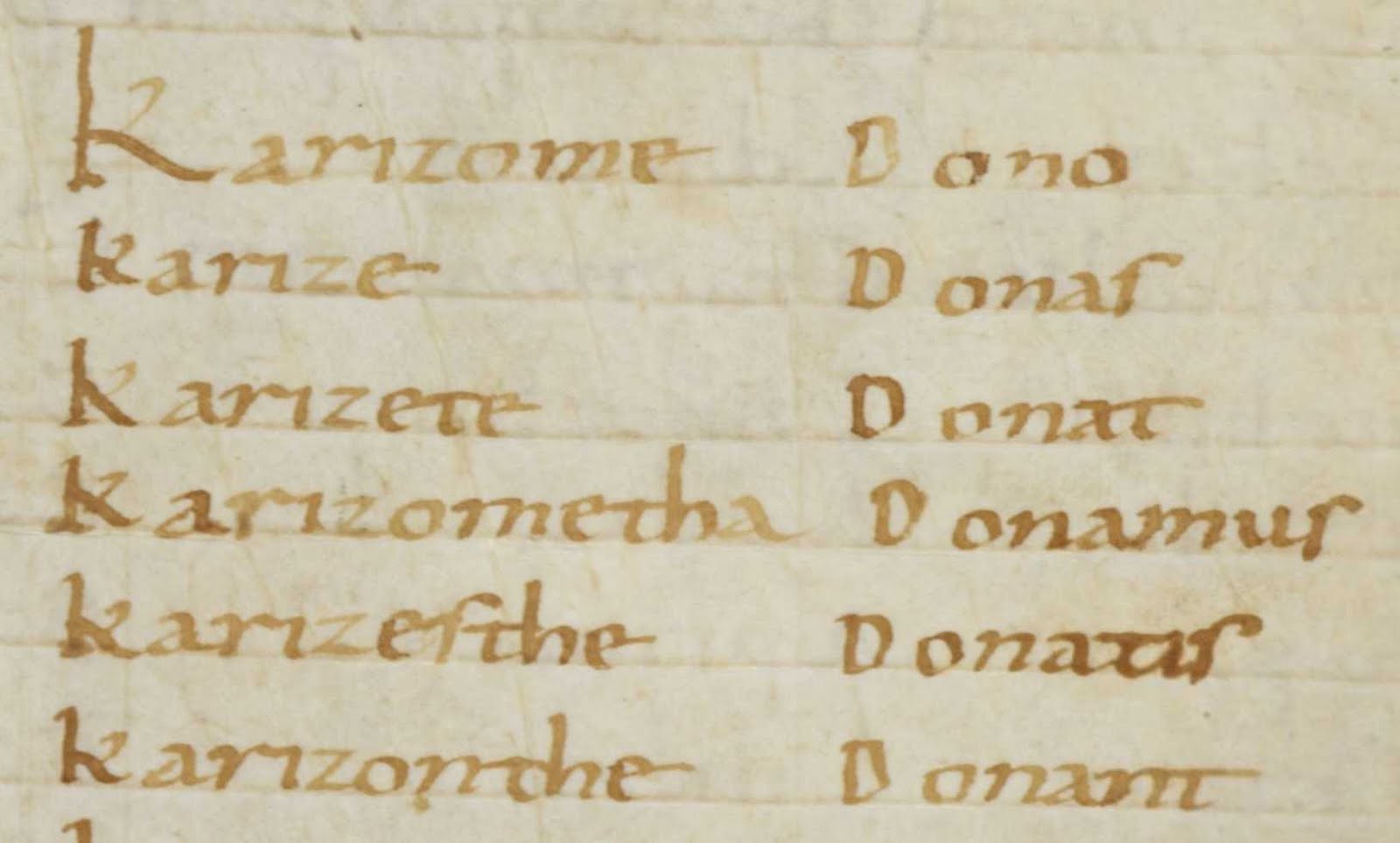
According to Gesenius, the Hebrew word “rimmon” actually means “pomegranate,” and the Arabic equivalent is “rumman”, which is quite similar to the Hebrew and shares the same RMN cognate[1]. Secondo Gesenius, il termine ebraico "Rimmon" in realtà significa "melograno", e l'equivalente in arabo è "Rumman", che è abbastanza simile a quello ebraico e condivide l'affine stesso RMN [1]. The following image would clearly illustrate this relation: La seguente immagine illustra chiaramente questa relazione:
“Pomegranate” is thus the proper translation of “rimmon” in the Bible (Numbers 20:5; Deuteronomy 8:8; 1 Samuel 14:12; Songs 4:3, 6:7). "Melograno" è dunque la traduzione corretta di "Rimmon" nella Bibbia (Numeri 20:5, Deuteronomio 8:8, 1 Samuele 14:12; Canzoni 4:3, 6:7). 'Rimmon' is also the name of a number of places mentioned in the Bible, specifically the Old Testament, named such because of the number of pomegranates that grow there. 'Rimmon' è anche il nome di un certo numero di luoghi menzionati nella Bibbia, in particolare l'Antico Testamento, chiamato così a causa del numero di melograni, che vi crescono. As Gesenius states: Come afferma Gesenius:
The pomegranate tree is still found in Syria, Palestine, and Egypt [...] From their abounding in pomegranates, several places received the proper name Rimmon[.][2] L'albero del melograno si trova ancora in Siria, Palestina ed Egitto [...] Dalla loro ricco di melograni, più luoghi ha ricevuto il proprio nome Rimmon [.] [2]
Examples of such places being named 'Rimmon' can be seen in Joshua 15:32, 19:7; Judges 20:47; 1 Chronicles 4:32 and Zechariah 14:10. Esempi di tali luoghi è chiamato 'Rimmon' può essere visto in Giosuè 15:32, 19:7, 20:47 giudici; 1 Cronache 4:32 e Zaccaria 14:10. Indeed, until today there is a specific place in Palestine called Rimmon (reysh-mem-vav-nun) in Hebrew, and Rammwan/Rummon (raa-meem-waw-nun) in Arabic, and it still exists today. Infatti, fino ad oggi vi è un luogo specifico in Palestina chiamato Rimmon (reysh-mem-VAV-suora) in ebraico, e Rammwan / Rummon (CRA-Meem-waw-suora), in arabo, ed esiste ancora oggi.
We can see that Rammwan/Rummon is thus the closest Arabic equivalent to the Hebrew “rimmon”, and not “Rahman” as Patriot Tim erroneously asserts. Possiamo vedere che Rammwan / Rummon è quindi il più vicino equivalente arabo ai ebraico "Rimmon", e non "Rahman", come afferma erroneamente Patriot Tim.
Referring to Strong's on RIMMON, the following entry is found: Facendo riferimento è forte su Rimmon, la seguente voce è trovato:
4. 4. A Syrian god (7417)[3] Un dio siriano (7.417) [3]
The BDB Lexicon has more information on RIMMON, and on p. Il Lessico BDB ha maggiori dettagli su Rimmon, e p. 942 we read that: 942 si legge che:
[Rimmon] n. [Rimmon] sm pr. pr. dei; as Rammanu, god of wind, rain and storm; thunder; storm.[4] Dei; come Rammanu, dio del vento, pioggia e tempesta, tuoni, tempesta [4].
There are two possible etymological explanations for the RIMMON of Syria. Ci sono due possibili spiegazioni etimologiche per il Rimmon della Siria. The first is from Gesenius, who says that it is “…perhaps the exalted, from the root RMM.”[5] The other possibility is that the spelling is a deliberate Jewish insult, and this is not uncommon in the Bible. La prima è di Gesenius, chi dice che è "... forse l'esaltato, la RMM da root." [5] L'altra possibilità è che l'ortografia è un insulto deliberato ebraico, e questo non è raro nella Bibbia. We read that Leggiamo che
“Rimmon” is an epithet of Hadad (Adad in Mesopotamia); the Akkadian form is Ram(m)an. "Rimmon" è un epiteto di Hadad (Adad in Mesopotamia), il modulo è accadico Ram (m) un file. It has been suggested that the Hebrew Rimmon, which is identical to the Hebrew word for “pomegranate,” is a deliberate mispointing of an original Ram(m)an (or something similar) to disparage the deity. È stato suggerito che la Rimmon ebraico, che è identico alla parola ebraica per "melograno", è una deliberata of mispointing un originale Ram (m) una (o qualcosa di simile) per screditare la divinità. This epithet Rimmon/Ramman is best understood as “thunderer” (cf. Akkadian ramanu “to roar,” hence “to thunder”). Questo epiteto Rimmon / Ramman si comprende meglio come "Tonante" (cfr ramanu akkadico "a rombo", quindi "a tuono"). Accordingly, the name Hadadrimmon means “Hadad is the thunderer.” Hadad, or Rimmon/Ramman, was the chief diety of the Arameans of Syria[.][6] Infatti, il nome Hadadrimmon significa "Hadad è il Tonante". Hadad, o Rimmon / Ramman, è stata la principale divinità degli Aramei della Siria [.] [6]
In light of Jewish traditions with disparaging name-games in Hebrew, we favour the possibility that calling the Syrian pagan idol as RIMMON was merely an attempt at insulting this pagan deity, and have no connections with “rimmon” meaning “pomegranate”. Alla luce della tradizione ebraica con il nome dispregiativo-games in ebraico, siamo favorevoli alla possibilità che chiama l'idolo siriano pagano come Rimmon era solo un tentativo di insultare questa divinità pagana, e non hanno alcun collegamento con "Rimmon" che significa "melograno".
This is already enough to refute the missionary's mendacity. Questo è già sufficiente per confutare del missionario menzogna. But let us take one step further and look up the meaning of the Arabic ar-rahman, as stated in Hans Wehr's Arabic-English Dictionary: Ma andiamo un passo avanti e cercare il significato della ar-Rahman arabo, come affermato nella Hans Wehr è arabo-English Dictionary:
ar-rahman : the Merciful (ie God)[7] ar-Rahman: il Misericordioso (cioè Dio) [7]
The root of ar-rahman is the word rahma, and from the very same page, we find that the root means La radice di ar-Rahman Rahma è la parola, e dalla pagina stessa, troviamo che la radice mezzi
pity, compassion; human understanding, sympathy, kindness; mercy[8] pietà, compassione, comprensione umana, la simpatia, la gentilezza, [misericordia 8]
Clearly, we certainly do not see any etymological relation at all with the Hebrew noun RIMMON (). Chiaramente, noi di certo non si vede alcun rapporto etimologico a tutti con il sostantivo ebraico Rimmon (). Indeed, one does not blindly assume that a word is connected to another simply by the play of sounds, and we need to look at several established rules for finding etymological connections. Infatti, non si assume ciecamente che una parola è collegata a un altro semplicemente il gioco di suoni, e abbiamo bisogno di guardare alcune regole stabilite per la ricerca di connessioni etimologiche. The rules are: Le regole sono:
So what does this mean? Che cosa significa? It means that the languages have to originate near one another, and indeed Hebrew and Arabic are from the same branch and area. Ciò significa che le lingue devono provenire uno vicino all'altro, e infatti ebraico e l'arabo sono della stesso ramo e settore. They have to share the same cognate, and lastly, they have to share the same meaning. Essi devono condividere l'affine stesso, e, infine, devono condividere lo stesso significato. While we do not deny that the Hebrew noun RIMMON conforms with criteria 1, it does not conform with criterias 2 and 3, and hence fails the ruling for determining whether RIMMON is indeed related to the Arabic word ar-rahman. Anche se non nego che la Rimmon sostantivo ebraico è conforme ai criteri 1, esso non è conforme con criteri 2 e 3, e non quindi la sentenza per stabilire se è effettivamente Rimmon legati alla parola araba ar-Rahman. As one of the greatest Philosophers of Language (one of the founding fathers of the field), Ludwig Wittgenstein, put it: Come uno dei più grandi filosofi del linguaggio (uno dei padri fondatori del campo), Ludwig Wittgenstein, messo:
The meaning of a word is its use in the language.[9] Il significato di una parola è il suo uso nel linguaggio [9].
The equivalent word for ar-rahman in the Hebrew would be “Ha-Rachman”, as found in Rivlin's Hebrew translation of the Qur'?n, 1:1: Il termine equivalente per ar-Rahman in ebraico sarebbe "Ha-Rachman", come si trova in traduzione ebraica Rivlin del Corano n '?, 1:1:
In the name of God, Ha-Rachman, the Merciful[10] In nome di Dio, Ha-Rachman, il [Misericordioso 10]
Apparently this title is not alien to the South Arabian Christians, for Philip K. Hitti informs us the following: Pare che questo titolo non è estraneo ai cristiani arabi del Sud, di Philip K. Hitti ci informa il seguente:
The earlier South Arabian civilization could not have altogether passed away without leaving some trace in its northern successor. La prima civiltà arabo Sud non poteva essere del tutto scomparso senza lasciare una traccia nel suo successore settentrionale. The inscription (542-3) of Abrahah dealing wih the break of the Ma'rib Dam begins with the following words: “In the power and grace and mercy of the Merciful [Rahman-an] and His Messiah and of the Holy Spirit”. L'iscrizione (542-3) del wih Abrahah affrontare la rottura della diga di Ma'rib inizia con le seguenti parole: "Per la forza e la grazia e la misericordia del [Misericordioso Rahman-an] e il suo Messia e dello Spirito Santo" . The word Rahman-an is especially significant because its northern equivalent, al-Rahman, became later a prominent attribute of All?h and one of His names in the Koran and in Islamic theology.[11] La parola Rahman, uno è particolarmente significativo perché il suo equivalente del nord, al-Rahman, divenne in seguito un attributo importante di tutte le h? E uno dei suoi nomi nel Corano e nella teologia islamica [11].
Philip K. Hitti further informs us in a footnote that Philip K. Hitti informa altresì a noi in una nota che
Rahmanan appears as title of the Christian God in a fifth-century South Arabic inscription.[12] Rahmanan appare come titolo del Dio cristiano in una iscrizione del V secolo Sud arabo [12].
So we see that the South Arabic Christians themselves using the appelation Rahmanan for their God, and hence we begin to see how perjurious the claims of the missionary really is. Così vediamo che i cristiani arabi Sud si utilizza l'appellativo Rahmanan per il loro Dio, e quindi cominciamo a vedere come perjurious delle affermazioni del missionario è davvero.
The Aramaic word for Rachaman/Rahman is rachamanaa, and indeed this is found in the Talmud. La parola aramaica per Rachaman / Rahman è rachamanaa, e infatti questo si trova nel Talmud. Consider the Aramaic text of Qiddushin 81b, where it is recommended that those looking to be protected from evil say: Consideriamo il testo aramaico dei Qiddushin 81B, dove si raccomanda che coloro che cercano di essere protetti da dire male:
Rachamanaa nighar beih ba-Satan Rachamanaa nighar beih BA-Satana
Translation: May the Most Merciful rebuke Satan. Traduzione: maggio il Misericordioso rimprovero Satana.
In the same part of the Talmud, there is a fascinating story about Rabbi Chiyya: Nella stessa parte del Talmud, c'è una storia affascinante di Rabbi Chiyya:
Rabbi Chiyya bar Ashi hawah raghil kal eedan dahawah nafal l'apeih hawah amar: ha-Rachaman yatsileinu miyetser haraa' Rabbi hawah Ashi raghil eedan kal dahawah Chiyya Bar L'apeih hawah Amar nafal: ha-Rachaman yatsileinu miyetser haraa '
Translation: Rabbi Chiyya bar Ashi had a practice where everytime he prostrated he would say “may the Most Merciful save us from evil inclinations”. Traduzione: Rabbi Chiyya bar Ashi era una pratica in cui ogni volta si prostrò diceva "può il Misericordioso salvarci da cattive inclinazioni".
So, even the great Talmud sages were doing as the Muslims do to this day, prostrating and giving homage to the Most Merciful, ar-rahman. Così, anche i grandi saggi Talmud stavano facendo come fanno i musulmani a questo giorno, prostrati e dare omaggio al Misericordioso, ar-Rahman. This passage from the Talmud is still relevant, as there is yet one more point to be made here. Questo passo del Talmud è ancora importante, poiché vi è ancora un punto in più per essere qui. Later in the story Rabbi Chiyya is tempted by his wife, who asks him to bring him a pomegranate. Più avanti nella storia Chiyya Rabbi è tentato dalla moglie, che gli chiede di portargli un melograno. She is quoted as saying: E 'citato come dicendo:
aiytei neehaleih l'hakh rumanaa d'reish tsutsitaa shawur aazal neehaleih aiytei l'rumanaa hakh d'shawur tsutsitaa reish aazal
Translation: Bring me that pomegranate on the uppermost branch. Traduzione: Bring me che melograno sul ramo più alto.
The word for pomegranate in the Aramaic is rumanaa, which is quite close to the Arabic rumman. La parola di melograno in aramaico è rumanaa, che è abbastanza vicino alla Rumman arabo. What we learn from this is that in Hebrew, Arabic, and even Aramaic (from this look at Qiddushin 81b), there is no connection between the word for “Most Merciful,” a name given to God, and pomegranate, a name heaped upon a pagan deity. Cosa ci insegna questa storia è che, in ebraico, arabo, aramaico e anche (da questo sguardo a Qiddushin 81B), non vi è alcuna connessione tra la parola per "misericordioso", un nome dato a Dio, e melagrana, un nome su colmo un pagano divinità.
This is further collaborated when we refer to the root word of ha-rachman, which is rachuwm, in Strong's number 7349 and find the following: Ciò è ulteriormente collaborato quando ci riferiamo alla radice della parola ha-Rachman, che è rachuwm, in Strong numero 7.349 e trova i seguenti:
rachuwm rakh-oom`; from 7355; compassionate:- full of compassion, merciful.[13] rachuwm rakh-OOM »; da 7.355, compassionevole: - pieno di compassione, misericordia [13].
Thus we see that rachuwm and rahma share the same RHM cognate, and thus we have established a solid etymological connection between both words. Così vediamo che rachuwm e condividere Rahma l'affine RHM stesso, e così abbiamo creato una solida connessione etimologica tra le due parole. Of course, there is another Hebrew word that is even closer to raheem (RHYM) than rachuwm is, and that is the exact Hebrew equivalent! Naturalmente, c'è un'altra parola ebraica che è ancora più vicino a Raheem (RHYM) rispetto rachuwm è, e che è l'ebraico equivalente esatto! Consider the following: Si consideri il seguente:
Summary Riassunto
As the final nail in the coffin, let us summarise what we have discussed above: Come l'ultimo chiodo nella bara, cerchiamo di riassumere quello che abbiamo discusso in precedenza:
1) RIMMON is a Syrian pagan god of thunder and the name itself is a noun and has nothing in common with ar-rahman, which is an attribute/appellation of God, as any Muslim schoolchild would know. 1) Rimmon è un pagano siriano dio del tuono e il nome stesso è un sostantivo e non ha nulla in comune con ar-Rahman, che è un attributo / appellativo di Dio, come ogni scolaro musulmano avrebbe saputo.
2) RIMMON has its roots in the Akkadian Rammanu, meaning “thunderer” or “to roar, to thunder” and its only connection to the “pomegranate” (rimmon) is that this is part of a deliberate Jewish insult against this pagan idol. 2) Rimmon ha le sue radici nella Rammanu accadico, che significa "tonante" o "a ruggire, a tuono" e la sua connessione solo per il "melograno" (Rimmon) è che questo fa parte di un insulto deliberato ebraico contro questo idolo pagano. “Rahman” came from a TOTALLY different root word, rahma, which means “pity; compassion; sympathy”, etc. "Rahman" proveniva da una diversa radice parola totalmente, Rahma, che significa "pietà, compassione," simpatia, ecc
3) RIMMON is the Syrian “god of wind, rain and storm”. 3) Rimmon è il siriano "dio del vento, la pioggia e la tempesta". By no stretch of imagination can this be applied to ALLAH, the God of Abraham(P), Moses(P), In nessun tratto di immaginazione può questo essere applicato ad Allah, il Dio di Abramo (P), Mosè (P), Jesus Gesù (P) and (P) e Muhammad Muhammad (P)! (P)! Further, we have seen how the South Arabian Christians themselves use the appelation Rahman-an (equivalent to the northern ar-Rahman) for God, and how the Aramaic phrase Rachamanaa is found in the Jewish Talmud. Inoltre, abbiamo visto come i cristiani arabi del sud si usa l'appellativo Rahman-an (equivalente a quelli del nord ar-Rahman) per Dio, e come la frase aramaica Rachamanaa si trova nel Talmud ebraico.
4) Nowhere in Strong's or in the BDB/Gesenius lexicons do we find any correlation of RIMMON with the Arabic word ar-rahman or its root word rahma. 4) In nessuna parte è forte o nella BDB / lessici Gesenius troviamo una correlazione di Rimmon con l'ar-Rahman parola araba o la sua Rahma parola radice. The Hebrew equivalent for rahma is the word rachuwm. L'equivalente ebraico per Rahma rachuwm è la parola. Both rahma (Ar.) and rachuwm (Heb.) share the same RHM cognate. Entrambi Rahma (Ar.) e rachuwm (Eb) condividono l'affine RHM stesso.
Conclusion Conclusione
It is evident that the missionary “Patriot Tim” clearly resorts to nonsensical and shoddy scholarship in order to discredit Islam, no matter how silly the 'theories' that he repeats. E 'evidente che il missionario "Patriot Tim" chiaramente ricorre a borsa di studio privo di senso e scadenti, al fine di screditare l'Islam, non importa quanto sciocco le' teorie 'che ripete. We suggest that “Patriot Tim” should stick to his current daytime occupation instead of trying to pass himself off as some sort of etymologist-cum-archeologist and parroting verbatim from monolingual polemicists like Morey. Si consiglia di "Patriot Tim" deve aderire alla sua attuale occupazione diurna invece di cercare di farsi passare come una sorta di etimologo-cum-archeologo e ripetere a pappagallo testualmente polemisti monolingui come Morey.
And only God knows best. E solo Dio sa meglio.
References Riferimenti
[1] William Gesenius, Hebrew and English Lexicon , (Crocker & Brewster, 1865), p. [1] Gesenius William, ebraico e il lessico inglese, (Crocker e Brewster, 1865), p. 982; cf JM Cowan (ed.), Hans Wehr's Arabic-English Dictionary , p. 982; Cowan JM CF (a cura di), Dizionario inglese-arabo di Hans Wehr, p. 360 360
[2] William Gesenius, Op. [] William Gesenius 2, op. Cit. , p. Cit., P. 982 982
[3] James Strong, The New Strong's Exhaustive Concordance of the Bible , under the word “RIMMON” [3] James Strong, The New Strong esaustiva Concordanza della Bibbia, sotto la parola "Rimmon"
[4] Under , The Brown-Driver-Briggs Hebrew-English Lexicon , p. [4] Sotto, La-Driver-Briggs Ebraico-Inglese Dizionario Brown, P. 942 942
[5] William Gesenius, Op. [5] Gesenius William, op. Cit. Cit.
[6] Frederic W. Bush, “HadadRimmon”, The Anchor Bible Dictionary , (Doubleday 1992), Vol. [6] Frederic W. Bush, "HadadRimmon", The Anchor Bible Dictionary, (Doubleday 1992), vol. 3, p. 3, p. 13 13
[7] JM Cowan (ed.), Hans Wehr's Arabic-English Dictionary , p. Cowan [7] JM (a cura di), Dizionario inglese-arabo di Hans Wehr, p. 332 332
[8] Ibid. [8] Ibid.
[9] Wittgenstein, Philophische Untersuchungen , pt. [9] Wittgenstein, Untersuchungen Philophische, pt. I, sect. I, sez. 43 43
[10] Yosef Yo'el Rivlin, Alkur'an / tirgem me-`Arvit , Devir, Tel Aviv (1936-1945) [10] Yosef Yo'el Rivlin, Alkur'an / me tirgem-`Arvit, Devir, Tel Aviv (1936-1945)
[11] Philip K. Hitti, [11] Philip K. Hitti, History Storia of the Arabs , The Macmillan Press, Ltd (1970), p. degli Arabi, La Stampa Macmillan, Ltd (1970), p. 105 105
[12] Ibid. [12] Ibid.
[13] James Strong, op. [13] James Strong, op. cit , under the word “rachuwm” , p. cit, sotto la parola "rachuwm", p. 131 131
Category: Categoria:
Allah (God) Allah (Dio) , , Islam Islam , , Polemical Rebuttals Polemici confutazioni
2 Responses for 2 risposte per "Allah is the RIMMON of Syria? A Reply to Christian Mendacity" "Allah è il Rimmon della Siria? Una risposta a menzogna cristiana"
[...] Well today, Islamic Awareness, a website which I would consider a highly-authoritative source of information with regard to Christian missionary, has updated their paper refuting this assertion and you can see it here. [...] Ebbene oggi, Islamic Awareness, un sito web che vorrei prendere in considerazione una fonte molto autorevole di informazioni con riguardo a Christian missionario, ha aggiornato la loro carta confutare questa affermazione e si può vedere qui. A related Christian polemic and postulation regarding Rahman being equivalent to “Rimmon” was also dealt in the past. Una polemica cristiana e connessi in materia postulazione Rahman equivalenti a "Rimmon" è stato trattato anche in passato. [...] [...]
[...] 20 December 2005Filed under Polemical Rebuttals, History Mohd Elfie Nieshaem Juferi It has always been the missionary tradition to jump from one nefarious claim to another in trying to ascertain the nature of “Allah”. [...] 20 dicembre 2005Filed sotto polemici confutazioni, Storia Mohd Elfie Nieshaem Juferi E 'sempre stata la tradizione missionaria a saltare da una pretesa nefandi ad un altro nel tentativo di accertare la natura di "Allah". We have previously shown some of the more common theories that they propagate, ranging from Allah(T) being the “moon god” to Ar-Rahman being a term for “pomegranate”. Precedentemente abbiamo indicato alcune delle teorie più comuni che si propagano, che vanno da Allah (T) è il "dio della luna" di Ar-Rahman è un termine di "melograno". A recent missionary allegation has also been hurled against a beatific salutation of the Prophet Muhammad sallallah `alayhi wa sallam. Una recente affermazione missionaria è stata anche lanciata contro un saluto beatifica del sallallah Profeta Muhammad `alayhi wa sallam. Now a new postulation of the missionary has been made in their article, namely that “Allah” is synonymous with the god Hubal of the pagan Makkans! Ora un nuovo postulato del missionario è stata fatta nel loro articolo, e cioè che "Allah" è sinonimo di Hubal dio del Makkans pagano! [...] [...]