

Introduction
In a study of logic, there is something which we call “undecidable propositions” or “meaningless sentences”, which are statements that cannot be determined because there is no contextual false. One of the classic examples cited is the Epiminedes’ paradox. Saul Kripke says:
Ever since Pilate asked, “What is truth?” (John XVIII, 38), the subsequent search for a correct answer has been inhibited by another problem, which, as is well known, also arises in a New Testament context. If, as the author of the Epistle to Titus supposes (Titus I, 12), a Cretan prophet, “even a prophet of their own,” asserted that “the Cretans are always liars,” and if “this testimony is true” of all other Cretan utterances, then it seems that the Cretan prophet’s words are true if and only if they are false. And any treatment of the concept of truth must somehow circumvent this paradox.
Saul Kripke, “Outline of a Theory of Truth”, Journal of Philosophy, Vol. 72, 1975, p. 690
Epimenides was Cretan and he said that “Cretans always lie”. Now, was that statement true or false? If he was a Cretan and he says that they always lie, is he then lying? If he is not lying then he is telling the truth and therefore Cretans do not always lie. We can see that since the assertion cannot be true and it cannot be false, the statement turns back on itself. It is like stating “What I am telling you right now is a lie”, would you believe that or otherwise? This statement thus has no true content. It cannot be true at the same time it is false. If it is true then it is always false. If it is false, it is also true.
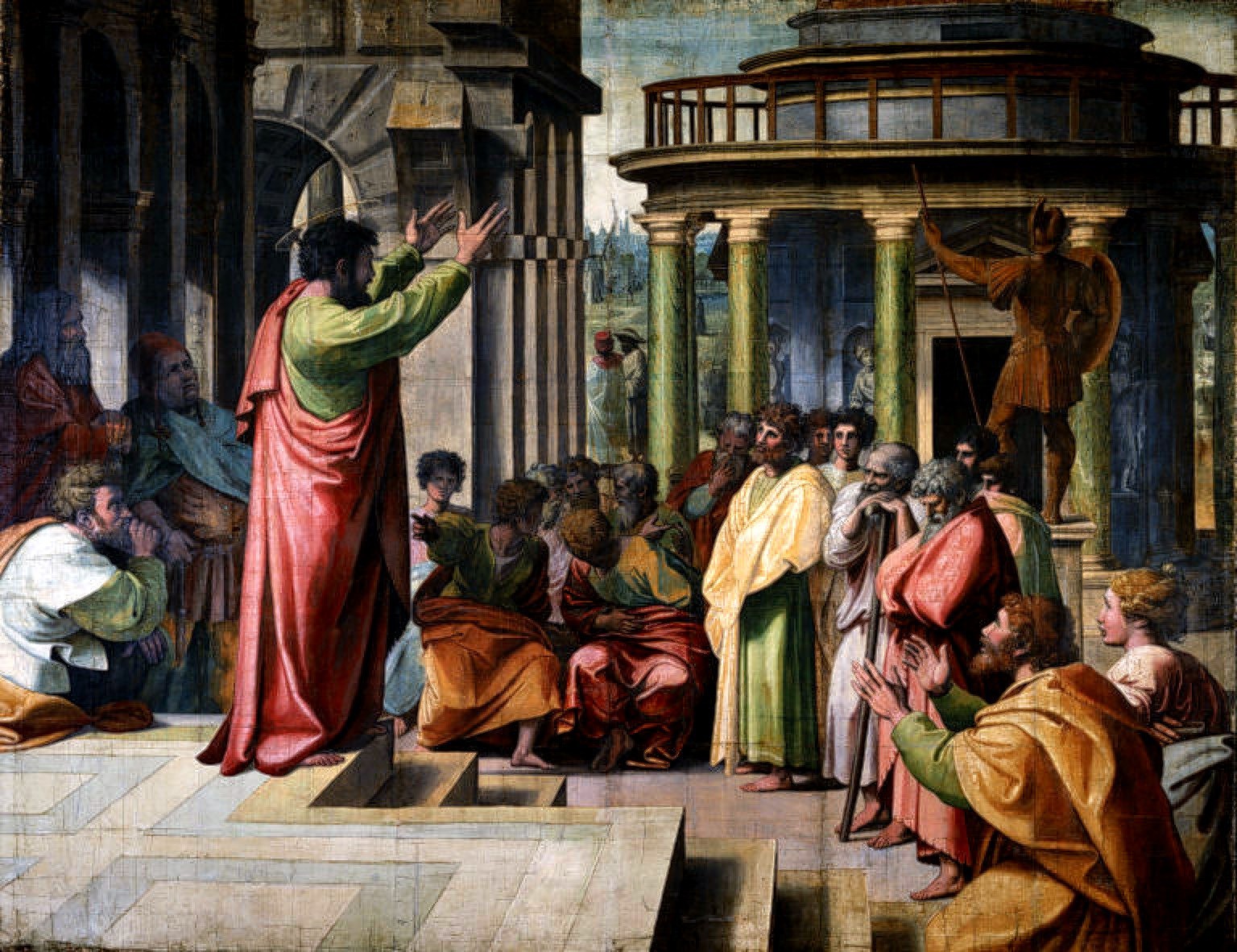
Paul Creates The Paradox
Well, in the New Testament, the writer is Paul and he is talking about the Cretans in 1 Titus, as follows:
A prophet from their own people said of them “Cretens are always liars, wicked brutes, lazy gluttons.” This testimony is true. For this reason correct them sternly, that they may be sound in faith instead of paying attention to Jewish fables and to commandments of people who turn their backs on the truth. (Titus 1:12-14)
Notice that Paul says that one of their own men — a prophet — said that “Cretans are always liars” and he says that what this man say is true. It is a small mistake, but the point is that it is a human mistake. It cannot be a true statement at the same time that it is a false statement. Thus, how can Christians claim that the writers of the New Testament — in this case, Paul — had “inspiration” from God?
Noted British logician Professor Thomas Fowler, who was in the 1800s, the Professor of Logic in Oxford and Fellow of Lincoln College, to sum up the problem created in Titus 1:12 that must necessarily falsify the inerrantist and the fundamentalist.
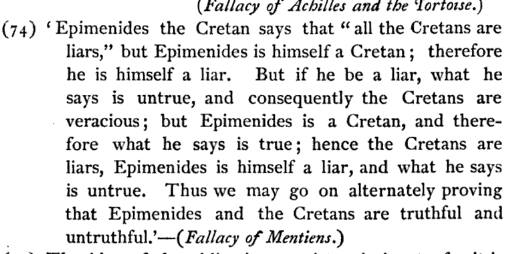
“Epimenides the Cretan says, ‘that all the Cretans are liars,’ but Epimenides is himself a Cretan; therefore he is himself a liar. But if he be a liar, what he says is untrue, and consequently the Cretans are veracious; but Epimenides is a Cretan, and therefore what he says is true; saying the Cretans are liars, Epimenides is himself a liar, and what he says is untrue. Thus we may go on alternately proving that Epimenides and the Cretans are truthful and untruthful.”
Fowler, T., The Elements of Deductive Logic: Designed Mainly for the Use of Junior Students in the Universities (Oxford: Clarendon Press, 1875), p. 171
Some Christians have taken the position that a strictly logical approach to Epimenides’ statement can result in it not being a paradox after all. If it is not a paradox, one may argue that Paul’s calling it “true” was a subtle bit of mockery with tremendous foresight regarding later developments in logic. If that is the case, then maybe Paul’s statement actually was inspired. For example, while discussing Paul’s comments in the epistle to Titus, one Christian theological periodical concedes that “one of the very greatest of Christian thinkers enters the logic books wearing a dunce’s cap”
There is the ancient paradox of Epimenides the Cretan, who said that all Cretans were liars. If he spoke the truth, he was a liar. It seems that this paradox may have reached the ears of St. Paul and that he missed the point of it. He warned, in his epistle to Titus: “One of themselves, even a prophet of their own, said The Cretans are always liars.” Actually the paradox of Epimenides is untidy; there are loopholes. Perhaps some Cretans were liars, notably Epimenides, and others were not; perhaps Epimenides was a liar who occasionally told the truth; either way it turns out that the contradiction vanishes.
Wilard Van Orman Quine, The Ways of Paradox and Other Essays (Harvard University Press, 1997), p. 6
The question that arises now is how Quine was able to figure out that maybe other Cretans were liars or maybe Epimenides sometimes told the truth. Epimenides is clearly saying that Cretans are always liars. Every time a Cretan speaks, he is lying, so how could the statement ever allow for a Cretan (be it Epimenides or some other Cretan) to speak the truth? The reasoning is genius, and goes as follows: the obvious assumption behind the belief that the statement is paradoxical is that if all Cretans lie, then Epimenides is lying, so if his statement is true, it is false. In that sense it seems like any other pseudomenon. From here, if we consider the statement false, we are no longer forced into the kind of paradoxical vicious circle that a true pseudomenon (like “this sentence is false”) pushes us into. Commenting on a similar line of argumentation, Schoenberg writes the following:
We may feel intuitively that the argument is paradoxical; yet, from a formal logic point of view, it does not really have the look of a paradox. It looks simply like reductio ad absurdum proof of the falsity of ‘All Cretans are liars.’
Judith Schoenberg, Belief and Intention in the Epimenides, Philososphy and Phenomenological Research, Vol. 30, 1968, p. 270
Thus, as Quine noted, it is not inconsistent to assume that some other Cretan does not always lie, or that some other statement by Epimenides was true. Prior explains this quite well:
If we treat the Cretan’s assertion as true, and so assume that nothing true is ever asserted by a Cretan, it follows immediately that the Cretan’s assertion is false. If, however, we treat it as false, there is no way of deducing from this assumption that it is true. We can, therefore, consistently suppose it to be false, and this is all we can consistently suppose. But to suppose it false (considering what the assertion actually is) is to suppose that something asserted by a Cretan is true; and this of course can only be some other assertion than the one mentioned.
A. N. Prior, “Epimenides the Cretan”, Journal of Symbolic Logic, Vol. 23, 1958, p. 261
A paradoxical statement has no discernable truth value, but the statement by Epimenides can be seen as having a truth value (i.e. it is false), and if that is the case we can reinterpret the statement as not being paradoxical. However, establishing a truth value for the statement does not escape the problem with Paul’s claim since the saying of Epimenides is false. As Prior noted above, we cannot consider the statement true (as Paul did). If sophisticated analysis determines after all that this statement by Epimenides is not paradoxical, and thus has a truth value, the only consistent supposition we can make is that it is false.
Conclusion
In the end, the following seven-point syllogism completes our argument:
- Paul claims a Cretan uttered a certain proposition.
- The proposition is not true.
- Paul claims the proposition is true.
- Paul’s claim is an error.
- Paul’s writings are errant rather than inerrant.
- Errant scripture is not inspired scripture, as held on by Muslims.
- Therefore, Paul was not inspired.
Hence, whether the statement is meaningless or false, the basic argument which we have raised still stands. The conclusion of the seven point syllogism given above still rings true: Paul was not inspired.
And only God knows best! 
A further discussion of the syllogism made here was elaborated in Epimenides Paradox Revisited.

(Just a note here, I am not a christian)
I think you need to be careful about such an argument because you are actually arguing from your own perspective (that is, not christian) and making a comment about Paul, rather than whether or not it would be truth FOR Paul.
Superficially it looks as if Paul doesn’t see the paradox of someone stating a contradictory idea. However, let us remember Paul actually refers to the person as a Prophet.
The question then becomes, what distinguishes a Cretan Prophet from a regular Cretan? Trivially its obvious that the answer is the person communicates prophecy.
So then we can inquire further, does the idea of prophecy circumvent the Paradox from Paul’s point of view?
The most reasonable way to outline our question further is to refine it a little and make it more specific: does the utterance from the prophecy come from the person or does the person receive the prophecy that they relate to others? If it is the former, and Paul believed that the person had powers of truth in his own right, then the paradox stands. If, however, Paul believed that the person had prophecies and truths revealed by god, then the paradox does not stand.
BECAUSE the christian prophet is understood to be a mouth-piece in which god projects his words onto – like a ventriloquist dummy there is no paradox. At least not here. Imagine the statement being like: The ventriloquist spoke from the mouth of the Cretan and said ‘all Cretans are liars’ the paradox simply doesn’t arise because it is the ventriloquist, not the Cretan, who is making the statement.
This is completely inkeeping with christianity ideas back to the start, and indeed what he says – It is the argument that humans become so corrupt that truth (god) could not abide with them, and they are redeemed in Jesus. Pauls comments then make more sense – it is testimony because it is from god, not the cretan,
Hence Pauls comment about the testimony being true – (To him) it is in-keeping with the word of god, and the solution is to embarrase or force them (not reason or persuade them with proof) to conform (to the message of god) as the nature of man (Themselves) is corrupt, of which (in this passage) Cretans are a particularly base-example.
BUT,
there is an argument against Christianity here that you can get if you think of Paul has reflecting the inversion of the paradox. That is, a Cretan uttered ‘all Cretans are absolutely truthful’. It is a kind of infinite, impenetrable bullshit loop that admits nothing else.
The statement is “proclaimed to be true because the proclaimer proclaims himself to be making a true statement which proclaims himself to be making a true statement which….” It can not be reasoned from or too as it is baseless and cyclical.
So Paul, if he is guilty of anything is the application of the inverse cretan (or prophet) argument. Which, of course, is the traditional method of Christians avoiding the sad deficiency at the heart of their own reasoning.
“A prophet stated ‘what is prophecy is true’.”
and that is christian faith. But i doubt that it is only christian faith that has this embedded in it ;-)
In surfing the web I periodically happen upon those trying to discredit the Apostle Paul (and by extension Christianity) via the claim his statements in Titus 1:12, 13 illustrate his error, naiveté or lack of divine inspiration. I have also come to regard those making such claims to be too clever by half as well as in error themselves.
Studies have shown that about a third of three-year-olds will knowingly make false statements. By four years of age or slightly older, 80% of children will have done the same and, by the age six, 95% of children will have knowingly made false statements. Why?
Children become cognizant of the fact that other people’s beliefs, knowledge and feelings are separate from their own. They can understand the concept of a false belief about reality and learn quickly that false belief can be used to accrue benefit in their favor by manipulating others. As cognitive sophistication develops, children are able to maintain their lies for far longer and will go so far as to even change their very behavior to make the falsehood appear plausible. Lying peaks around the ages of four to six. At this age, children will lie indiscriminately. They devise strategies and test various lies, remembering when they’ll work and when they won’t. By trial and error, they soon come to the realization that one cannot always get away with a lie and will, in large part, gradually modify their behavior according by limiting lies to situations in which they will appear plausible.
As children grow older the reasons for lying become more complex. Avoiding punishment is still a primary catalyst for lying, but lying also becomes a way to increase a child’s power and sense of control. Manipulating friends with teasing, bragging to assert status and learning that parents can be fooled are all examples. Many children will lie to their peers as a coping mechanism, as a way to vent frustration or get attention.
On the basis of empirical studies then, I’d have to conclude the idea that anyone can reach adulthood without having ever knowingly made a false statement is untenable. There’s no need to take my word for it, however, as plenty of experts will attest to this.
Julian Keenan, a Montclair State University professor and director of the university’s Cognitive Neuroimaging Laboratory, has been researching the world of deception for 10 years and believes everyone knowingly makes false statements. Keenan states the average person knowingly makes at least one false statement per day.
University of Massachusetts psychologist Robert Feldman has conducted experiments in which two strangers are placed in a room together and videotaped while engaging in conversation. In subsequent interviews, Feldman had the individuals watch the videotape and identify any statements they made that were not entirely accurate. Interestingly, subjects that initially commented that their statements were entirely accurate were genuinely surprised to discover that they had in fact knowingly made inaccurate statements. The inaccuracies ranged from pretending to like someone actually disliked to falsely claiming to be the star of a rock band. Ultimately, the study – published in the “Journal of Basic and Applied Psychology” – found that 60% of people had knowingly made false statements at least once during the 10-minute conversation, making an average of 2.92 inaccurate statements. Just as professor Keenan had determined in his studies, Feldman discovered that men tended to make false statements in order to make themselves look better while women were more likely to make false statements in order to make others feel better.
As it’s a near certainty that each and every one of us has at one time or another (most likely during childhood) knowingly made a false statement and that knowingly making a false statement is defined as lying, we have all lied. Moreover, as we have all lied, we are all – by definition – liars. Although we may later come to regret, confess and ask forgiveness for having told a lie, telling a lie is a unique temporal event that cannot be undone – once a false statement has been knowingly made, it cannot be taken back as it becomes the intellectual property of the past. As a lie can never be taken back, we will always be liars even if we never tell another lie. As an unfortunate result, all of us (not just the inhabitants of Crete) are always liars.
Therefore, when Paul in quoting a Cretan wrote “The Cretans are always liars” and buttressed the claim by further stating “This witness is true,” he was precisely correct irrespective of who made the statement and its obvious he fully thought the matter through by virtue of his seemingly ironic insistence the statement was true when many would think it a paradoxical statement. Although all of us will always be liars by virtue of knowingly making at least one false statement in the past, this cannot by any means be taken to mean that every statement we will ever make will be a known falsehood. This is why it’s possible for a Cretan to accurately state that Cretans are always liars.
I remember coming across this statement by Paul in 1 Titus having a chuckle at how this paradox seems to have gone right over his head.
I used to imagine him sitting in a Roman cell while the guards would entertain each other with jokes or the latest brain twisting paradox going about. In my minds eye I would see Paul catching a snippet of the conversation as the first guard told the paradox to the second guard, and while the second guard’s brain was starting to mull it over, Paul would scurry to the back of his cage, oblivious to the rest of the debate, grab a scrap of parchment and scribble with righteous indignation. “I knew it” he would be thinking, “I knew Cretans were all lying scum. Now even a Cretan admits it!!”
I think this was probably a quality that helped him become a success in religious endeavours. When you’re busy trying to start a religion you need the ability to grab onto any sliver of evidence that supports your preconceived notions and to never let logic get in the way.