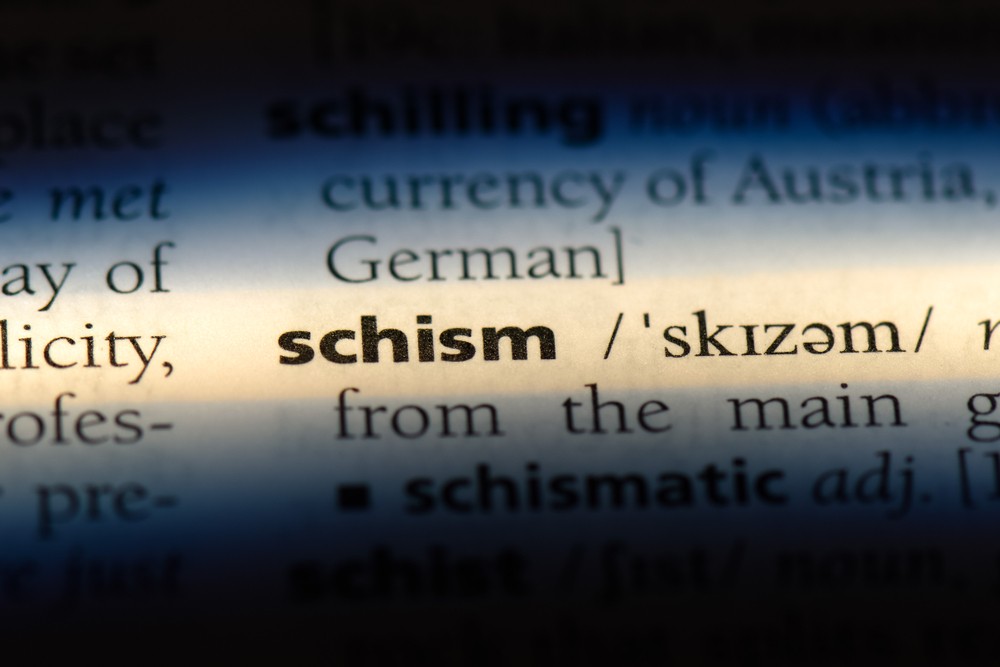
1. 1. It is important to realize that, unfortunate as it may be, it is a division that has already been made and accepted by the Muslims and by the adherents of these sections. Es importante darse cuenta de que, lamentable, ya que puede ser, es una división que ya se ha hecho y aceptado por los musulmanes y los seguidores de estas secciones. It would, under the circumstances, be unrealistic to refute the existence of these sects. Sería, dadas las circunstancias, ser poco realista para refutar la existencia de estas sectas. These sections do exist, even if their existence is against the teachings of the Qur'an and the Sunnah of the Prophet (P), but it would be self-deception to assume that they will cease to exist in the near future. Estas secciones no existen, incluso si su existencia está en contra de las enseñanzas del Corán y la Sunna del Profeta (P), pero sería un autoengaño pensar que van a dejar de existir en un futuro próximo.
2. 2. There is a tradition which declares that Hay una tradición que se declara que Islam Islam has 72 (73, according to another version) sects. tiene 72 (73, según otra versión) sectas. 1 1 It is usually argued that this narration patronizes or even encourages the formation of sects in Islam. Por lo general se argumentó que esta narración patrocina o promueve la formación de sectas en el Islam. Even though its sanad does not have any flaw, but its meaning is usually not understood. A pesar de que su sanad no tiene ningún defecto, pero su significado por lo general no se entiende.
Its correct understanding can be either of the following: Su correcta comprensión puede ser cualquiera de los siguientes:
“… hold fast, all of you together, to the cable of Allah, and do not separate…” [Qur'an, 3:103] (Pickthall's tr.) "... Se aferran, todos juntos, con el cable de Alá, y no se separan ..." [Corán 3:103] (Pickthall tr.)
Hence in light of this way of explanation, it is clear that this narration does not encourage the formation of sects, but, on the other hand, warns the Muslims to keep themselves away from those activities, which lead to the formation of sects. Por lo tanto a la luz de este modo de explicación, es evidente que esta narración no fomenta la formación de sectas, sino que, por otra parte, advierte a los musulmanes a mantenerse alejados de las actividades, que conducen a la formación de sectas.
3. 3. From the basic definition of a “Sect” in Islam, we may regard as real sects in Islam as only those groups, whose members departed from the Sunnah on essential issues of fundamental importance for Islam, and who, on such issues, contradict the Ijma'. De la definición básica de una "secta" en el Islam, podemos considerar como sectas real en el Islam, ya que sólo los grupos, cuyos miembros se apartó de la Sunnah sobre cuestiones esenciales de fundamental importancia para el Islam, y que, en cuestiones como, en contradicción con la Ijma '.
Ash-Shahrastani in his famous al-Milal wan-Nihal (1:4) writes that the faith of Sunni Muslims was nothing else but the principles of Islam set forth by the Prophet(P) himself, and the “Sects” in Islam were outside of the Sunni faith, and were four only: al-Qadriya, As-Sifatiya, al-Khawarij and Shi'a. Ash-Shahrastani en su famoso al-Milal wan-Nihal (1:4) escribe que la fe de los musulmanes sunitas no era más que los principios del Islam establecido por el Profeta (P) a sí mismo, y el "sectas" en el Islam fueron los fuera de la fe suní, y fueron sólo cuatro: al-Qadriya, As-Sifatiya, al-Khawarij y chiíes.
Division of this kind dates back to the early days of Islam and was not (initially) caused by questions of religion, but by the questions of the constitution of the new state. División de este tipo se remonta a los primeros tiempos del Islam y no fue (inicialmente) por cuestiones de religión, sino por las preguntas de la constitución del nuevo estado. Since politics is but a part of the “Deen” of Islam, therefore these political questions were blended very soon with the religious backing, and thus the sectarianism became sound and permanent. Dado que la política no es sino una parte del "Din" del Islam, por lo tanto estas cuestiones políticas se mezclaron pronto con el apoyo religioso, el sectarismo y por lo tanto se convirtió en el sonido y permanente.
Ash-Shahrastani in al-Milal wan-Nihal writes: Nihal Ash-Shahrastani en al-Milal wan-escribe:
In every age, the greatest number of times the swords were drawn was on the issue of Imamate, rather than on any other issue. En todas las edades, el mayor número de veces que las espadas se elaboraron estaba en el tema de la Imamate, más que en cualquier otro tema. 3 3
Ash-Shahrastani has mentioned the following events to be the causes Ash-Shahrastani ha mencionado los siguientes acontecimientos a ser las causas 4 4 of true sectarianism in Islam: de cierto sectarismo en el Islam:
4. 4. From today's perspective, the differences in the various Muslim groups are of the following nature: Desde la perspectiva actual, las diferencias en los distintos grupos musulmanes son de la siguiente naturaleza:
[b] Secondary Differences: These differences are related to the subordinate and minor issues of prayer, zakat , interpretation of Qur'an, etc. These differences exist among the Sunnis, between Ahl-e-Hadith, the four fiqah s, etc. [B] Las diferencias secundarias: Estas diferencias están relacionadas con el menor y cuestiones subordinadas de la oración, el zakat, la interpretación del Corán, etc Estas diferencias existen entre los sunitas, entre los Ahl-e-Hadith, los cuatro Fiqah s, etc
Now, differences of type [b] can be eliminated to a reasonably acceptable degree by permitting the respective group to follow its own set of inheritance or family etc. Laws (which will be called its “Personal Law”), but restricting all the groups to follow the Civil & the Criminal Law of that Group, whose adherents are in majority in the area in question. Ahora, las diferencias de tipo [b] puede ser eliminada a un grado razonablemente aceptable, al permitir el respectivo grupo para seguir su propio conjunto de leyes de la herencia o la familia, etc (que se llamará la "Ley de Personal"), pero restringiendo todos los grupos para seguir el Civil y el Código Penal de ese Grupo, cuyos partidarios están en mayoría en la zona en cuestión.
So, in Pakistan, for example, the Law of the Land is the Hanafi interpretation of the Qur'an and the Sunnah, while all other groups are free to follow their respective Personal Law. Por lo tanto, en Pakistán, por ejemplo, la Ley de la Tierra es la interpretación Hanafi del Corán y la Sunnah, mientras todos los demás grupos son libres de seguir su ley personal respectiva.
Welcome to Bismika Allahuma , your premier source of counter-missionary information from an Islamic perspective! Bienvenido a Bismika Allahuma, su principal fuente de información del contador-misionera desde una perspectiva islámica! If you are new here, you may want to get regular updates via Si eres nuevo aquí, puede que desee para obtener actualizaciones regulares a través de RSS feed RSS . . Thank you for visiting! Gracias por su visita!